What Is Asbestos Insulation? A Simple Guide to Types, Appearance, Risks and Locations
Asbestos insulation was widely used across the UK throughout much of the 20th century. It was popular because it provided excellent heat insulation and fire protection. At the time, asbestos was considered a strong, reliable, and low-cost building material.
However, it was later discovered that asbestos fibres are extremely dangerous when inhaled. Exposure can lead to serious and often fatal illnesses. Because of these risks, asbestos was fully banned in the UK in 1999. Even so, many older buildings still contain asbestos insulation today.
This guide explains what asbestos insulation is, what it looks like, where it can be found, and what to do if you think your property contains it.
What Is Asbestos Insulation?
Asbestos is a natural mineral made up of tiny fibres. These fibres are very strong and resistant to heat, fire, and chemicals. Because of these properties, asbestos was commonly added to insulation materials used in homes, offices, factories, ships, and public buildings.
Asbestos insulation includes a wide range of materials, such as pipe coverings, sprayed coatings, insulation boards, loose-fill insulation, papers, textiles, and fireproof panels. In total, thousands of different asbestos-containing products were made and installed throughout the UK.
Buildings built or refurbished before the year 2000 may still contain asbestos insulation, even if they look modern.
Why Was Asbestos Used for Insulation?
Asbestos became popular because it performed extremely well. It does not burn, making it excellent for fire protection. It also helps prevent heat loss, improving energy efficiency. These qualities made asbestos ideal for insulating pipes, boilers, heating systems, walls, ceilings, and steel structures.
Another reason asbestos was widely used is because it was cheap and easy to produce. Large-scale manufacturing made it affordable, and it quickly became a standard building material across the construction industry.
Unfortunately, the serious health dangers were not fully understood until many years later.
Health Risks of Asbestos Insulation
Asbestos materials are generally safe if they are in good condition and left undisturbed. The danger occurs when asbestos is damaged, drilled, cut, broken, or allowed to deteriorate. This releases tiny fibres into the air, which can easily be inhaled.
Breathing in asbestos fibres can cause serious long-term illnesses, including mesothelioma, lung cancer, and asbestosis. These conditions often take decades to develop, meaning people may not show symptoms until 20 to 60 years after exposure.
Because of these severe health risks, strict regulations now control how asbestos is managed and removed.
What Does Asbestos Insulation Look Like?
Asbestos insulation can look very different depending on how and where it was used. In many cases, it is hidden behind walls, ceilings, floors, and pipe coverings, making it difficult to identify without professional inspection.
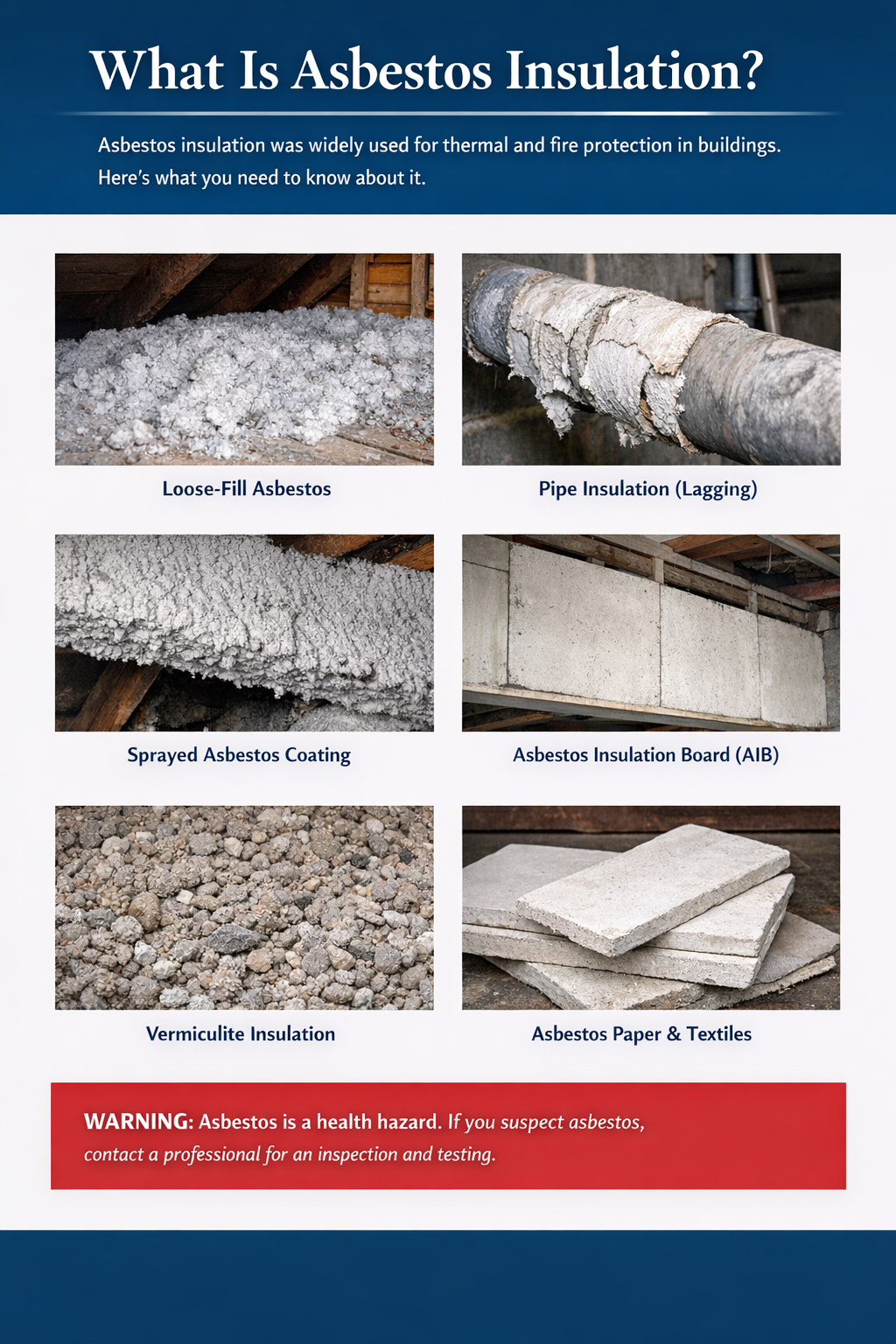
Loose-fill asbestos insulation looks soft and fluffy and may be white, grey, blue, or brown. It was commonly poured into loft spaces and wall cavities and is considered one of the most dangerous forms due to its high fibre release.
Pipe insulation, also known as lagging, often looks like a thick plaster coating wrapped around pipes and boilers. It is usually white or grey and may be covered with cloth, foil, or metal. Over time, it can become cracked and crumbly.
Sprayed asbestos coatings were applied to ceilings, walls, and steel beams for fire protection. These coatings have a rough, uneven surface and are common in older industrial buildings, warehouses, and car parks.
Asbestos insulation board looks similar to plasterboard but is usually denser and more brittle. It was widely used in partition walls, ceiling panels, soffits, and fire protection barriers.
Vermiculite insulation consists of small, pebble-like granules, usually grey-brown in colour. Some older vermiculite products were contaminated with asbestos and may pose a risk.
Asbestos was also used in paper, cardboard, and textile products such as pipe wraps, rope seals, fire blankets, gloves, and heat-resistant linings. In some buildings, raw asbestos fibre was packed into gaps as a firebreak.
Where Is Asbestos Insulation Commonly Found?
Asbestos insulation is most commonly found in buildings constructed or refurbished before 1985, although it may still appear in buildings built up to 1999.
It is often present in loft spaces and wall cavities, especially as loose-fill or vermiculite insulation. Pipes, boilers, and hot water tanks frequently contain asbestos lagging. Ceilings and structural beams may have sprayed coatings or insulation boards applied for fire protection.
Heating and ventilation systems may contain asbestos within ductwork, seals, and insulating linings. Electrical panels and fuse boards sometimes used asbestos as a fire-resistant barrier. Roofing materials, including felt, tiles, and soffits, can also contain asbestos.
Why Building Age Matters
The age of a building is one of the best indicators of whether asbestos insulation might be present. Buildings constructed before 1945 may contain asbestos, but its use increased significantly after the Second World War.
Properties built between 1945 and 1985 have the highest likelihood of containing asbestos materials. Buildings constructed between 1985 and 1999 still carry some risk, as asbestos products were only fully banned in 1999.
However, building age alone cannot guarantee whether asbestos is present or not. The only reliable way to confirm is through a professional asbestos survey.
What Should You Do If You Suspect Asbestos?
If you believe your property may contain asbestos insulation, it is important not to disturb it. Avoid drilling, sanding, cutting, or removing any suspect materials.
Instead, contact a qualified asbestos surveyor who can carry out an inspection and arrange laboratory testing if required. If asbestos is confirmed, a management plan can be put in place, or professional removal can be arranged if necessary.
Attempting to handle asbestos yourself can be extremely dangerous and may also breach health and safety regulations.
Final Thoughts
Asbestos insulation remains a serious concern in older UK buildings. Because it can appear in many different forms and is often hidden, it continues to pose a risk during renovation, repair, and demolition work.
Understanding what asbestos insulation looks like and where it may be found helps reduce the risk of exposure and keeps both occupants and workers safe. When in doubt, always seek professional advice.